
A Dead-End Paradigm
When malignant pathology governs a nation

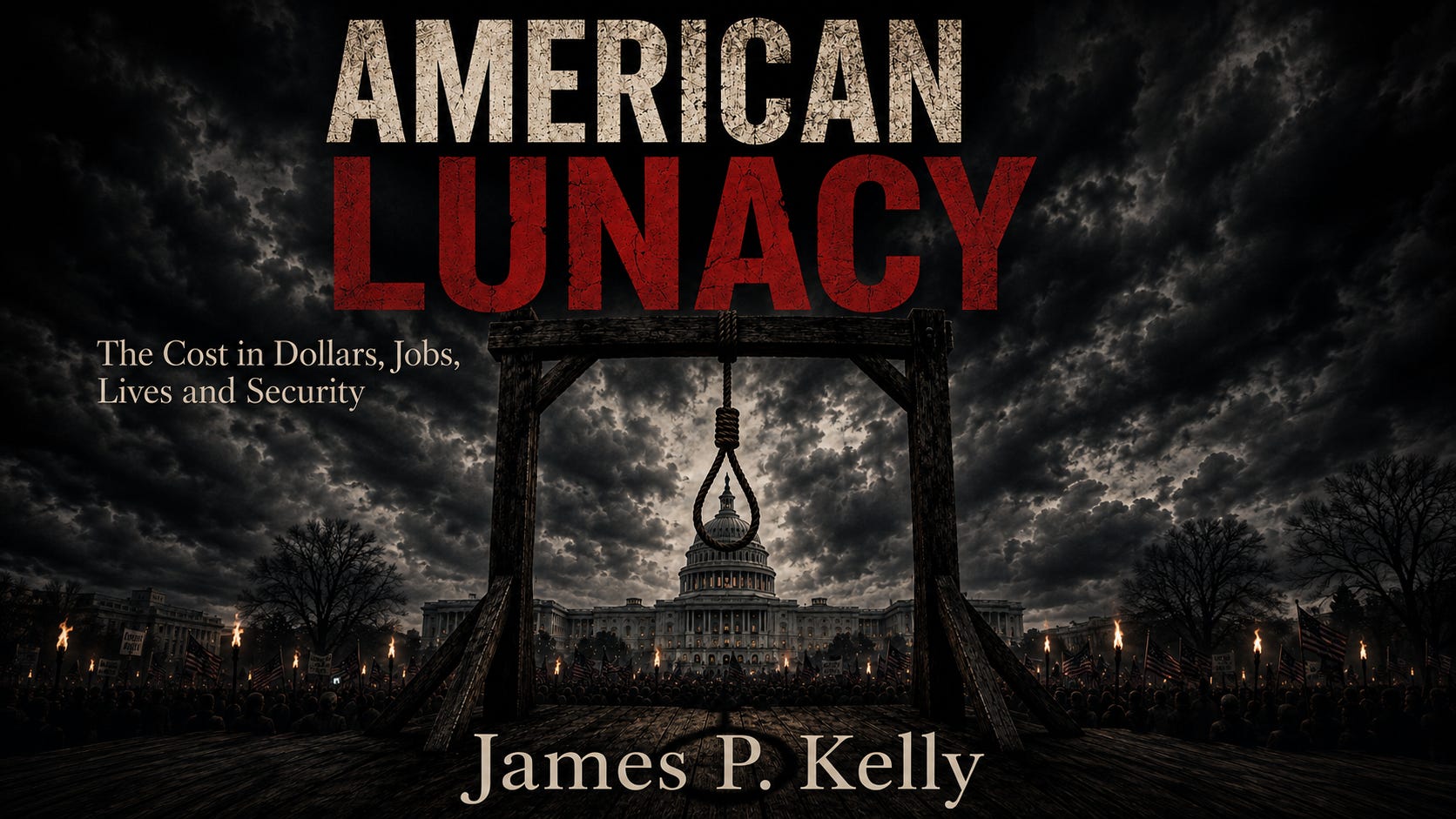
Note: The following substack is an excerpt from chapter six of American Lunacy: The Cost in Dollars, Jobs, Lives, and Security. Free downloads of it are offered here in PDF and EPUB. It’s also available on Amazon for 99 cents.
The Existential Threat
Forensic psychiatrist Bandy X. Lee warned in 2018 that “fascism is a society-level mental disorder cloaked in political ideology.”
That warning in Psychology Today becomes clearer when fascism is understood not only as an authoritarian dictatorship, but—as Benito Mussolini described it—as the merger of pathological leadership with pathological incentives governing corporate, political, and institutional behaviors.
The defining traits of malignant narcissism, which President Trump consistently displays in his public behavior according to Dr. Lee and dozens of her peers, are not harmless personality quirks.
Grandiosity exaggerates confidence while suppressing caution.
Impaired reality perception turns evidence into a personal attack.
Lack of empathy removes human suffering from moral assessment.
Self-interest replaces conscience.
Exploitation converts people and institutions into inanimate tools.
Refusal of accountability prevents learning, correction, restraint, or growth.
Placed in ordinary life, those traits destroy families, friendships, organizations, and communities. Placed in the Oval Office, they can destabilize the economy, destroy nations, and threaten the world. Placed as the operating system of a captured society, they must logically lead to its catastrophic harm.
Such a paradigm—powerful economic and political interests driven by pathological incentives and protected by pathological leadership—is not merely a threat to America’s democracy. It is a dead-end threat to humanity and Nature.
Fascism as a Mortal Danger
Benito Mussolini once said that fascism should more appropriately be called “corporatism” because it represents “the merger of state and corporate power.”
Trump did not seize power alone. He was installed, protected, and sustained by a political party, billionaires, corporations, ideological organizations, media systems, and social movements who believed they could profit from his pathology.
His contempt for oversight served those seeking deregulation.
His hostility toward truth served those threatened by science, investigation, and accountability.
His readiness to punish enemies and refute democratic norms served those seeking permanent political and social domination.
His indifference to harm served industries and institutions accustomed to externalizing their costs onto workers, communities, future generations, and the natural world.
They saw those traits as assets because they mirrored their own. They assumed they could use them without being touched by their inherent risks. That assumption may be one of the most dangerous mistakes in human history.
Climate change already exceeds the limits of social resilience. Addressing it requires scientific reality, long-term planning, inter-national cooperation, restraint, sacrifice, and collective action across generations. Malignant narcissism rejects each of those requirements:
It denies unwelcome evidence, elevates self-interest over moral implications, treats compromise as weakness, and views limitations as personal affronts.
A society governed by those traits will not respond to climate danger until catastrophe becomes impossible to ignore—and perhaps not even then—because meaningful action would conflict with...
a fossil-fuel industry that continues to profit,
political movements that weaponize disbelief,
media systems that monetize disagreement,
and a divided public conditioned to stay divided.
Meanwhile, Nature remains oblivious to propaganda. Atmospheric chemistry doesn’t care what humans believe, and run-away global temperatures won’t spare us because our leaders deny they’re real.
The same danger applies to infectious disease. Pandemic prevention requires surveillance, scientific expertise, public trust, international information sharing, vaccine development, and institutions capable of acting before a threat becomes visible to everyone. Yet the Trump administration has weakened those very capacities.
Medical warning systems are dismantled because experts contradict ideological preferences.
International cooperation is rejected.
Vaccine confidence is undermined.
The research infrastructure is disrupted.
Preparedness is sacrificed to grievance, spectacle, and political self-interest.
And yet, viruses don’t care which political faction wins.
A pathogen will exploit every laboratory closure, every warning delayed, every expert silenced, every vaccination refused, and every international channel severed.
The dismantling of preparedness does more than threaten public health. It creates the very conditions under which a future outbreak could spread faster, kill more people, overwhelm institutions, destabilize economies, and deepen the very fear that authoritarian leaders crave to expand their power.
The nuclear danger is even more immediate.
The president of the United States possesses extraordinary authority over the world’s most destructive weapons. That authority now rests with a leader of whom mental-health professionals describe as grandiose, impulsive, detached from reality, incapable of empathy, intolerant of contradiction, and driven by self-interest, humiliation, dominance, and revenge.
Those traits are dangerous in any leader. In a nuclear-armed president, they’re an existential threat to life on Earth.
A wounded ego can become a military crisis. A delusion can become strategy. A demand for loyalty can silence the advisers most capable of preventing catastrophe. An ego’s compelling need to appear strong can override restraint. A personal grievance can be projected onto nations, populations, and alliances.
Once institutions are hollowed out and expertise is silenced, the safeguards surrounding presidential power become weaker or non-existent precisely when they are needed most.
The danger is compounded by oligarchic and corporate capture.
Politicians, donors, industries, media allies, and ideological movements that benefit from having Trump in power have strong incentives to minimize, deny, or rationalize his instability. Their wealth, access, tax advantages, deregulation, contracts, and political power all depend upon preserving the arrangement.
The system therefore protects the pathology that threatens us, and a dead-end paradigm remains entrenched and primed for self-destruction:
The leader cannot tolerate reality.
The institutions around him cannot tolerate losing access to his power.
The public cannot unite to remove him because identity capture has made cooperation intolerable.
The threats continue to grow. Climate systems destabilize. Medical defenses weaken. Nuclear danger intensifies. Truth becomes partisan. Correction becomes betrayal. Stalemate becomes success.
This is why America’s lunacy is not merely America’s problem.
A nuclear exchange won’t respect national borders. A pandemic won’t obey immigration laws. Climate collapse won’t distinguish between political parties. Environmental destruction won’t spare the wealthy.
And yet, can you imagine a point at which:
the fossil fuel industry says, “We’ve made enough profits. We should prioritize the environment, human health, and the future”?
pharmaceuticals urge researchers, “Let’s cure diseases, so we can quit profiting from them”?
gun makers tell Congress, “Please restrict who can buy our guns, so children won’t be slaughtered in schools”?
ideological organizations say, “We need to hold our wealthy donors, corporate sponsors, and political allies to the same moral standards we apply to everyone else”?
billionaires declare, “We’re rich enough”?
a severely narcissistic tyrant no longer demands he be given more power?
In short, there’s a reason why psychologist Mary Trump, PhD.,i niece of Donald Trump, entitled a book about her uncle, Too Much and Never Enough.ii
That phrase applies to much more than just one man. It captures a system whose appetite for wealth, power, consumption, and control recognizes no practical or moral limits. It is always too much—and it will never be enough.
The pathology explains the behavior.
The incentives reward it.
The division prevents correction.
Dr. Lee’s warning—that fascism is a society-level mental disorder—describes a society that loses its empathy, rejects reality, glorifies domination, externalizes harm, punishes dissent, and converts human vulnerability into opportunities for power and profit.
It describes what too much of America already is and where its future could lead due in part to the conditioned apathy, complacency, and division of its people.
The natural world will absorb the consequences of America’s pathology until it can’t. We’ll then discover—if we don’t learn it sooner from economic collapse, pandemic deaths, or nuclear war—why pathology matters.
In Conclusion:
Humans possess the ability to ruin the planet’s climate, weaponize pathogens, poison the environment, automate propaganda, surveil populations, and destroy themselves with nuclear weapons. Survival depends upon restraint, cooperation, reality-based judgment, and concern for people not yet born.
America’s dead-end paradigm rewards the opposite: denial, domination, division, immediate gain over long-term survival, and leaders who cannot distinguish strength from destruction.
The system does not need to intend extinction.
It needs only to remain in place while protections erode and dangers deepen. Over a million American deaths from COVID-19 did more than expose its deadly cost. They were a tragic warning where such a system must inevitably lead.
A Final Note:
In September 1939, King George VI of Great Britain addressed a nation facing a fascist threat. America now confronts the same primitive doctrine—might makes right—advancing through executive power, institutional capture, concentrated wealth, manufactured division, and the corruption of shared reality.
The circumstances are not the same, and the response required is not armed warfare, but democratic resistance: truth over propaganda, courage over intimidation, solidarity over engineered hatred, public service over self-interest, and peaceful unity against those seeking to place themselves above the law and beyond accountability.
But the ultimate issue remains the same. A civilized society cannot survive indefinitely if selfish power may disregard honor, justice, and human decency, break every restraint, punish contradictions, and call its oppression “being great.”
George VI spoke at an hour when the danger could no longer be denied. His words belong here because America must recognize the principle confronting it before its own dark days become even darker.
King George VI—September 3, 1939
“In this grave hour, perhaps the most fateful in our history, I send to every household of my peoples, both at home and overseas, this message, spoken with the same depth of feeling for each one of you as if I were able to cross your threshold and speak to you myself. For the second time in the lives of most of us, we are at war.
“Over and over again, we have tried to find a peaceful way out of the differences between ourselves and those who are now our enemies; but it has been in vain.
“We have been forced into a conflict, for we are called, with our allies, to meet the challenge of a principle which, if it were to prevail, would be fatal to any civilized order in the world. It is a principle which permits a state, in the selfish pursuit of power, to disregard its treaties and its solemn pledges, which sanctions the use of force or threat of force against the sovereignty and independence of other states.
“Such a principle, stripped of all disguise, is surely the mere primitive doctrine that might is right, and if this principle were established through the world, the freedom of our own country and of the whole British Commonwealth of nations would be in danger.
“But far more than this, the peoples of the world would be kept in bondage of fear, and all hopes of settled peace and of the security, of justice and liberty, among nations, would be ended. This is the ultimate issue which confronts us. For the sake of all that we ourselves hold dear, and of the world order and peace, it is unthinkable that we should refuse to meet the challenge.
“It is to this high purpose that I now call my people at home, and my peoples across the seas, who will make our cause their own. I ask them to stand calm and firm and united in this time of trial.
The task will be hard. There may be dark days ahead, and war can no longer be confined to the battlefield, but we can only do the right as we see the right, and reverently commit our cause to God. If one and all we keep resolutely faithful to it, ready for whatever service or sacrifice it may demand, then with God’s help, we shall prevail.
“May He bless and keep us all.”
##
i Trump, M.L., The Good in Us by Mary L. Trump. MaryTrump.org
ii Wikipedia, Too Much and Never Enough, Wikipedia.org,