
When Systemic Pathology Threatens the Nation
Part Four: The Cost in Human Lives

Introduction:
Mental-health professionals have described Donald Trump’s public behavior through his consistently visible traits: grandiosity, lack of empathy, moral judgment aligned with self-interest, indifference to harm, exploitation and manipulation of others, impaired reality perception, and refusal of accountability.
In order for psychologists and psychiatrists to diagnose narcissistic personality disorder (NPD) in human patients, the DSM-5-TR (The Diagnostic and Statistical Manual of Mental Disorders) requires a patient’s pervasive pattern of behavior to display at least 5 of the following 9 traits:
Has a grandiose sense of self-importance (e.g., exaggerates achievements and talents, expects to be recognized as superior without commensurate achievements).
Is preoccupied with fantasies of unlimited success, power, brilliance, beauty, or ideal love.
Believes that he or she is “special” and unique and can only be understood by, or should associate with, other special or high-status people (or institutions).
Requires excessive admiration.
Has a sense of entitlement (i.e., unreasonable expectations of especially favorable treatment or automatic compliance with his or her expectations).
Is inter-personally exploitative (i.e., takes advantage of others to achieve his or her own ends).
Lacks empathy: is unwilling to recognize or identify with the feelings and needs of others.
Is often envious of others or believes that others are envious of him or her.
Shows arrogant, haughty behaviors or attitudes.
Because President Trump frequently displays indifference when causing other to suffer, moral judgments based solely on self-interest, and distorted reality perception, psychologist Drew Westen, PhD., characterizes his disorder as a severe sub-type of narcissism: “malignant narcissism,” which combines narcissistic traits with sadistic psychopathy.
Part One of this series examined what happens when those traits affect national security. Part Two put them into context with political corruption and economic policy. Part Three revealed them through government spending.
Part Four counts their costs in lost human lives.
Some of the numbers that follow are documented deaths. Others are estimates modeled on established mortality data. Others are projections of deaths already placed in motion by policy decisions.
The above-listed symptoms chose the priorities. The priorities chose the policies. The policies choose who’s to die. Their deaths expose our danger.
Snapshots:
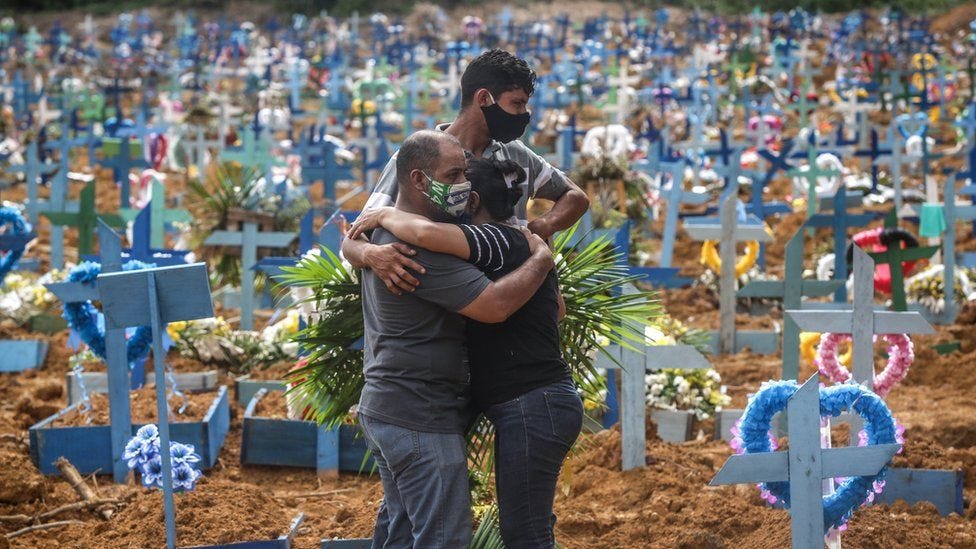
Nearly 188,000 American COVID deaths that might have been avoided:
The Lancet Commission estimated that approximately 40 percent of U.S. COVID-19 deaths through the end of 2020 — nearly 188,000 people — might have been avoided if U.S. mortality had matched the average of the other G7 nations.
A congressional investigation based on more than 200,000 pages of documents and testimony from senior officials found that Trump administration officials blocked CDC public briefings, suppressed scientific reports, weakened public-health guidance, and sought to downplay the danger of COVID in service of Trump’s political goals.
Trump’s own former White House Coronavirus Response Coordinator, Dr. Deborah Birx, later testified to Congress that the White House was “distracted about its reelection” and that the administration repeatedly underplayed the seriousness of the pandemic, creating a false sense of security and delaying effective action.
Olivia Troye, a former adviser to Vice President Mike Pence and member of the White House coronavirus task force, was blunter: “It was all about the election.”
Nearly 188,000 Americans might have lived had the United States merely matched the average mortality performance of comparable nations.
Trump feared that acknowledging the pandemic’s severity—and the economic disruption required to contain it—would jeopardize his reelection.
Pathology Link: lack of empathy; indifference to harm; manipulation of truth; impaired reality perception; morality shaped by self-interest; refusal of accountability.
Source: The Lancet
Source: House Oversight Committee
Source: House Oversight Committee
Source: Reuters
At least 135 people killed in the Guadalupe River floods—including 27 Camp Mystic campers and counselors
On July 4, 2025, catastrophic flash flooding tore through the Texas Hill Country after the Guadalupe River rose more than 20 feet in less than an hour. At least 135 people died. Twenty-five girls and two teenage counselors were killed at Camp Mystic.
The National Weather Service issued forecasts and flood warnings. But the Austin/San Antonio office responsible for the region had no warning coordination meteorologist—the official whose job included working with emergency managers, police, firefighters, and media to ensure that weather information became timely public action. The position was vacant due to Trump administration’s federal staffing reductions.
That vacancy mattered.
A warning on a screen is not the same as a trained official calling local authorities directly and making the danger unmistakable: The river is coming. Get those children out now.
Investigations have not established that the vacancy alone caused any specific death. But the administration had removed a key emergency-coordination function from a region historically prone to severe flash-flooding—and people died amid failures in communication, evacuation, and public response.
Former NOAA officials expressed concern that this vacancy may have impaired communication with local authorities and emergency response even though alerts were issued.
Pathology Link: Reckless destruction of protective institutions; contempt for expertise; grandiose certainty that experienced personnel were expendable; indifference to foreseeable harm; refusal of accountability; denial of reality.
Source: AP News
Source: Factcheck.org
Source: KOAT Action 7 News
Source: E&E News by Politico
At least 10 deaths on American streets directly connected to ICE operations:
The Associated Press reports that at least 10 people have died in encounters or incidents connected to immigration-enforcement operations since Trump began his mass-deportation campaign. The circumstances differ. The pattern does not: armed federal enforcement, fear, pursuit, intimidation, and violent death have become recurring features of Trump’s deportation campaign.
Pathology Link: Domination; coercion; indifference to harm; punishment elevated into governing authoritarian spectacle.
Source: AP News
At least 52 people dead in ICE custody
Human Rights Watch and Physicians for Human Rights documented at least 52 deaths in ICE custody during the first 500 days of Trump’s current administration. Reuters separately found that the death rate inside immigration detention centers had more than doubled since Trump returned to office.
These people were already in government custody. The government controlled where they slept, what medical care they received, and whether their calls for help were answered.
Pathology Link: Indifference to harm; dehumanization; coercive institutional expansion; refusal of responsibility.
Source: Human Rights Watch
Source: Reuters
Fourteen U.S. service members have died in Trump’s Iran war
As of July 13, 2026, 14 American service members had died during the Iran war and more than 400 had been wounded. Many of the wounded suffered traumatic brain injuries. The decision to launch and escalate an undeclared war without clear aims originated with Trump and his administration.
Pathology Link: Grandiosity; dominance converted into military policy; indifference to human consequences; refusal to recognize limits.
Source: AP News
At least 3,636 people killed in Iran — including 254 children
By April, the U.S.-based Human Rights Activists in Iran had counted 3,636 deaths since the U.S.-Israel war with Iran began. The organization identified 1,701 civilians among the dead, including at least 254 children.
Renewed American and Iranian attacks mean the death count is already dated. Not every Iranian death was caused by an American weapon. But these are human beings killed in a war that Trump chose to enter, expand, and repeatedly escalate.
Pathology Link: Grandiose military escalation; impaired assessment of consequences; dominance; indifference to harm.
Source: Reuters
More than 150 children and 12 teachers killed at school
CNN reports that a U.S. missile struck the Shajareh Tayyebeh Elementary School in Minab, Iran, on February 28, and killed more than 150 children and 12 teachers. U.S. Senior Commanders were warned beforehand that the targeting was based on “obviously old information” that needed to be vetted for accuracy. Sources say they ignored the warning out of “expediency.”
Pathology Link: Indifference to harm; grandiose military escalation; refusal of accountability.
Source: Reuters, Common Dreams, Daily Beast
At least 211 people killed in U.S. military strikes on boats
By June 19, at least 211 people had been killed in U.S. military strikes on boats the Trump administration alleged were involved in drug trafficking. No evidence prior to their being killed or since has connected their actions to criminal intent. They were not arrested or tried for a crime.
Pathology Link: Domination; indifference to harm; punishment without ordinary institutional restraint; moral judgment aligned with the leader’s asserted interests.
Source: PBS.org
Approximately 780,000 modeled deaths from USAID cuts in one year — including 518,000 children
When the Trump administration froze and dismantled USAID programs, Boston University global-health researcher Brooke Nichols began modeling the expected mortality consequences.
Her expanded Impact Counter estimated that, over the one-year horizon following the cuts, approximately 262,000 adults and 518,000 children would die as a result of disrupted USAID-funded programs.
Approximately 780,000 modeled deaths. More than half a million children.
These are modeled estimates of expected excess deaths due to funding being cut for USAID. The models estimate mortality produced when funding disappears from programs addressing, tuberculosis, malaria, severe malnutrition, diarrhea, HIV/AIDS, and other preventable causes of death.
The Trump Administration did not shoot them. It decided to walk away and let them die.
Pathology Link: Indifference to harm; moral judgment aligned with self-interest; grandiose confidence in destructive policy; refusal to accept consequences.
Source: GBH News
Source: ImpactCounter.org
Methodology: ImpactCounter.org
More than 14 million additional deaths projected by 2030 if USAID defunding continues
A separate international study published in The Lancet estimated that continued deep cuts and near-complete dismantling of USAID programs could result in more than 14 million additional deaths by 2030.
More than 4.5 million of those deaths would be children under the age of five.
This is a future projection. It is also a pathological warning written in human lives.
Pathology Link: Indifference to harm; inability or unwillingness to integrate consequences into decision-making; self-interest; refusal of accountability.
Source: The Lancet
More than 51,000 preventable American deaths projected every year from health-policy changes
Researchers affiliated with the University of Pennsylvania and Yale projected that health-care provisions in the 2025 budget reconciliation legislation could cause more than 42,500 deaths annually.
Their analysis estimated 11,300 deaths from loss of Medicaid or Affordable Care Act Marketplace coverage, 18,200 deaths connected to low-income Medicare beneficiaries losing Medicaid-linked prescription-drug subsidies, and 13,000 deaths associated with rollback of federal nursing-home minimum staffing rules.
The researchers then added the expected effect of failing to extend enhanced ACA premium tax credits: another 8,811 deaths.
Total projected preventable deaths: More than 51,000 every year.
Pathology Link: Indifference to harm; policies aligned with financial and political self-interest; exploitation of vulnerable populations; refusal to accept predictable consequences.
Source: U. of Penn.edu
More than 22,000 additional deaths from worsened air pollution in one year
The Lancet Commission estimated that Trump’s first-term hostility to environmental regulation worsened pollution and resulted in more than 22,000 additional deaths in 2019 alone.
The Commission linked the increase primarily to rising fine-particulate air pollution after the administration weakened enforcement of clean-air protections and reversed environmental and workplace safeguards. Fine-particle pollution contributes to cardiovascular disease, stroke, lung cancer, and chronic respiratory illness.
There was no explosion. There were no schools in ruins. There were no flag-draped coffins lined up for television cameras. People breathed. They became sick. They died.
Pathology Link: Indifference to harm; corporate and political self-interest; hostility toward evidence and institutional restraint; consequences made invisible through distance and time.
Source: aljazeera.com
Source: The Lancet
Why Pathology Matters
Yesterday we measured pathology in squandered dollars. Today we measured it in squandered human lives. The danger is not only that these deaths reveal pathological forces shaping our society. The danger is what public reactions to these deaths reveal about us.
When the Guadalupe River swept through the Texas Hill Country, Americans were horrified. They saw flooded campgrounds, missing children, shattered families, rescue crews, and communities overwhelmed by grief. Texans who had visited those campgrounds, traveled those roads, or knew the victims must have felt the loss with even greater force.
That reaction was human.
Now place beside it more than 22,000 additional deaths from air pollution. Or more than half a million modeled child deaths after the suspension of USAID programs. Or 52 people dead in ICE custody.
Did those deaths produce the same shock?
More to the point, does who and what we are — liberal, conservative, Christian, non-Christian, Trump supporter, Trump opponent, republican, democrat, rich, poor, etc. — affect which deaths grab our attention and seem to matter and which do not?
This is not a moral accusation. It is a warning about psychological vulnerability.
We do not experience every death equally, even when every life has equal human value. Proximity matters. Familiarity matters. Visibility matters. Group identity matters. The words used to describe the dead matter.
A child who died at a Texas summer camp may feel innocent and familiar. A child dying overseas after a humanitarian program disappears may feel faceless and distant. A child killed in an Iranian school by an American missile may be emotionally dismissed as collateral damage.
A person who dies in ICE custody can be morally filtered through the label “illegal.” A person killed on a boat may be presumed deserving of death if the government asserts he was trafficking drugs. A death caused by air pollution barely registers since there is no explosion, no devastation, and no televised evidence connecting the death to fossil fuels.
People who died of COVID were dismissed as old, unhealthy, and likely to die soon anyway.
The point of this is not to say we should feel grief or feel the same over every human death. The point is that our reactions to specific deaths can vary according to our priorities, beliefs, affiliations, biases, convenience, ambitions, and comfort.
Therefore, those reactions are not entirely our own.
How we perceive other humans, or entire groups of people, is vulnerable to manipulation, especially if they differ from us. If it were not, propaganda would not exist. It would not have persuaded populations throughout history to fear their neighbors, hate them, tolerate cruelty, support injustice, excuse mass suffering, or participate in atrocities.
Psychologist Drew Westen, PhD., describes one form of this process as “themification.”
Once we see other people or groups as “them” — as outsiders who do not belong to our in-group or our race, our religion, our class, or “our type” of people — we begin to lose empathy for them. Their suffering feels less real. We doubt their innocence automatically. Their deaths become easier to rationalize, ignore, or forget.
Americans did not acquire this talent from Trump alone.
For decades, political messaging, commercial media, racial and religious scapegoating, economic fear, and engineered polarization have conditioned the public to see selected groups as outsiders, inferior, undeserving, morally deficient, or dangerous.
I call this socially divisive programming “weaponized division,” because its purpose is to spawn social division, intensify it, entrench it, and profit from it as a weaponized means of social control.
The strategy is ancient: divide and conquer.
Trump inherited a society already conditioned for social mistrust and resentment. His pathology exploited it personal power.
Madeline Taylor, PhD., has observed that Trump cannot tolerate people thinking differently from him. That aspect of his pathology amplifies and spreads when empowered by the Oval Office.
Trump displays little empathy, so neither does his grassroots base.
Trump sees reality only as he wants to see it. So, too, does MAGA.
Both Trump and his followers are indifferent if others are harmed through policies good for Trump and his backers.
Forensic psychiatrist Dr. Bandy X. Lee warned us of “Trump contagion.” i.e., the spread of Trump’s narcissistic symptoms through his followers, America’s institutions, and society at large.
That contagion and our divisive conditioning are revealed when Americans rate the importance of human deaths and the value of the lives that were lost according to the corpse’s nationality, race, religion, legal status, sexual orientation, age, social class, or political registration.
The Guadalupe River tragedy proved that Americans haven’t lost the capacity for empathy. Its unequal application to other deaths shows how selectively our emotions can be activated, channeled, amplified, dampened, or switched off.
This truth concerning sympathy is equally true concerning fear, anger, jealousy, and outrage. That is the warning inside the warning.
A president’s mental symptoms threaten human lives through the policies he pursues because of them. America’s systemic pathology and our exposure to Trump threaten our humanity and human life itself.
The first kills human bodies. The second kills our capacity to stop it. Together, they explain why according to Dr. Bandy X. Lee, “Fascism is a society-level mental disorder cloaked in political ideology.”
The cure must begin by removing our exposure to Trump.
Part One, Part Two, Part Three
James P. Kelly
author of Weaponized Division: What Broke America — How We Repair It